A website for a small business can cost anything from a few dollars a month for a do it yourself builder to $50,000 or more for a fully custom site from an agency. Most owners who want a site that actually brings in customers end up somewhere in the middle. The honest answer to “how much does a website cost?” is another question: what do you need the website to do?
This guide breaks down what each price range gets you, what drives the cost up, the costs cheap websites leave out, and how to decide what is right for your business.
The short answer
Here is roughly what the market looks like in 2026:
- Do it yourself builders like Wix or Squarespace: usually $20 to $50 a month, plus your own time.
- A freelancer using a template: often $1,000 to $5,000.
- A small studio or agency building a custom site: commonly $5,000 to $30,000.
- A larger agency, with research, strategy and a full brand: $30,000 to well over $100,000.
These ranges overlap, and prices vary by city and by who you hire. What separates them is not the website itself. It is how much thinking, design and writing goes into it before anyone builds a page.
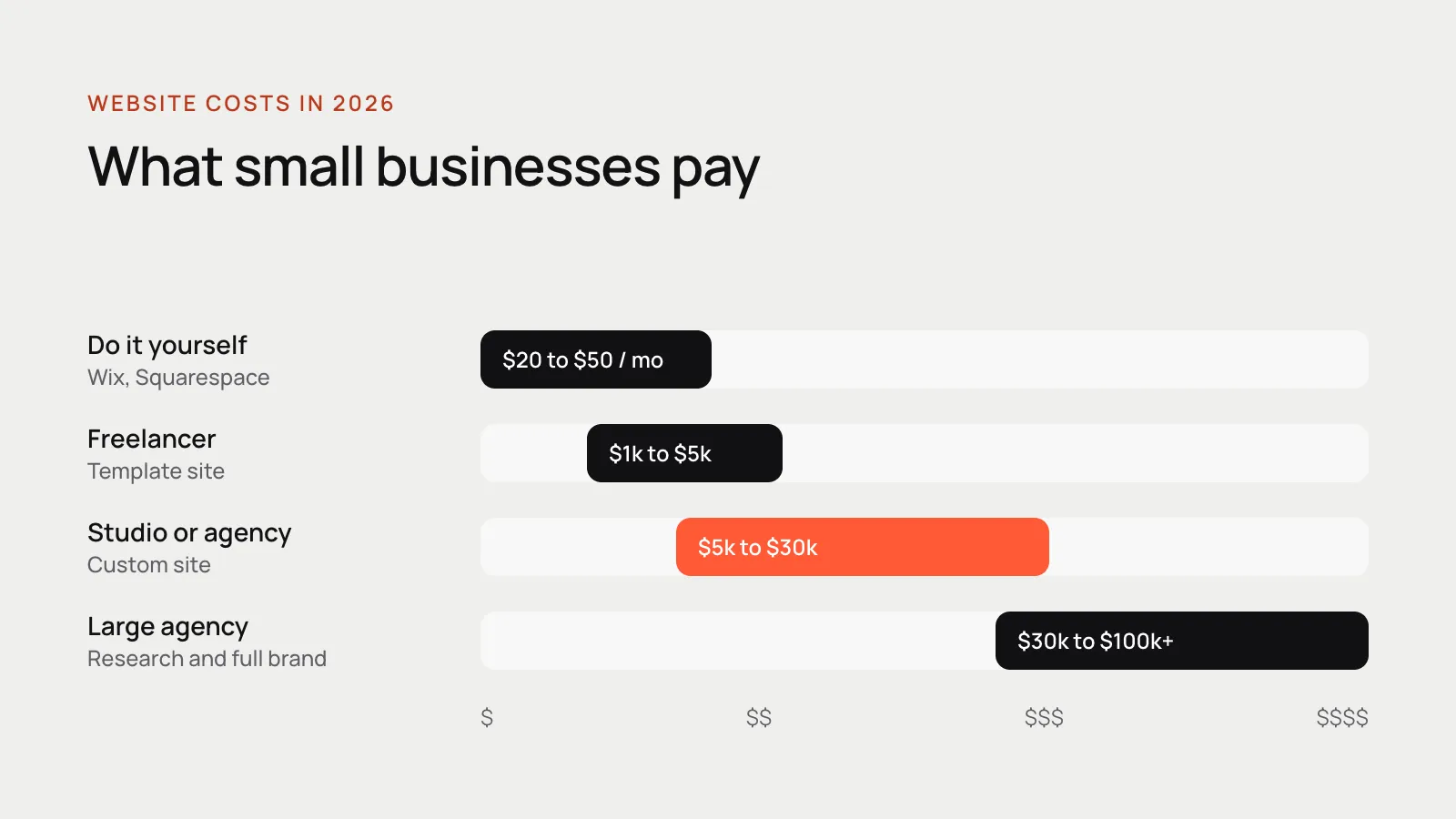
Typical ranges, not quotes. Prices vary by city and by who you hire.
What each price range gets you
A do it yourself builder gets you a working site fast. You pick a template, swap in your text and photos, and publish. It is cheap in money and expensive in time, and it tends to look like the template it came from, because thousands of other businesses started from the same one.
A template site from a freelancer saves you the setup. Someone else installs the template, adds your content and makes it work on phones. You usually still write the copy and supply the photos yourself, and the design stays close to the template.
A custom site from a studio or agency is designed for your business specifically. That usually means a real layout built around your services, copy written to turn visitors into calls, and a basic search setup so you can be found on Google.
A branded website goes one step further. Before the site is designed, the brand is: your logo, colors, type and the way you talk about your business. The website is then built from that brand, so every page looks and sounds like one confident company instead of a collection of templates.
What makes a website cost more
Four things drive most of the price:
- Brand work. A logo, a color palette, type and a clear message take real design time. A site built without them borrows them from a template.
- Custom design. Every page laid out for your content, on phones and on desktop, instead of filled into someone else’s layout.
- Copy. Words that explain what you do, why you are different and what to do next. Good copy is often the difference between a visit and a phone call, and it is usually the first thing cheaper options leave to you.
- Search setup. Page titles, descriptions, speed, structure, your Google Business Profile and, more and more, being understood by AI search tools like ChatGPT. This is the work that decides whether anyone finds the site at all.
Extras like online booking, payments, a large number of pages or connections to other software add to the price on top of these.
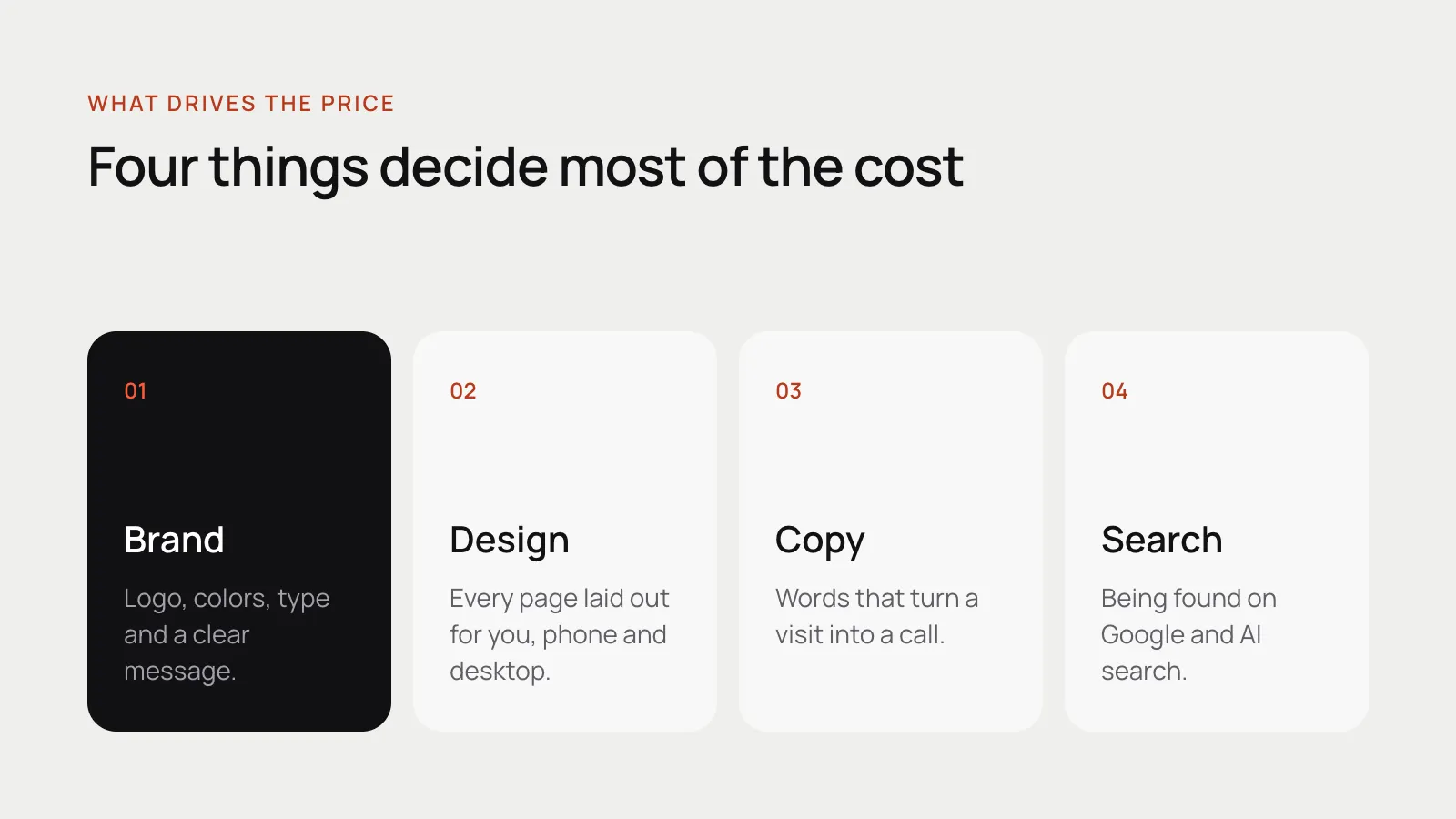
Brand, design, copy and search decide most of the price.
Website or branded website?
A website is a set of pages that describe your business. A branded website makes your business look like the obvious choice.
The difference shows up in what customers feel in the first few seconds. Big companies are rarely better at the actual work than a great local business. They just look more trustworthy, because everything they put out looks like it comes from the same, well run company. A branded website gives a small business that same first impression, and with it the confidence to charge what the work is worth.
That is also why a branded website costs more than a template site. You are paying for the brand and the website together, designed as one thing, instead of a site that has to borrow its look from somewhere else.
The costs cheap websites leave out
A low quote can turn out expensive. These are the costs that often show up later:
- Writing the copy yourself, usually at night, usually rushed.
- Photos, because template stock photos make you look like everyone else.
- Search setup, which many cheap sites skip entirely. A site nobody finds is not cheap at any price.
- Speed and mobile performance, which affect both rankings and how many visitors stay.
- A redesign sooner, because a site that does not represent the business well gets replaced within a couple of years instead of growing with you.
- Lost customers, the cost nobody sends an invoice for: people who visited, did not trust what they saw and called a competitor.
A real example: Moving On Relocation
Moving On Relocation learned this the expensive way. Before they came to us, they had paid a lot of money for a WordPress website. On paper, it was a finished site. In practice:
- It kept getting hacked. WordPress and its plugins were out of date, and nobody was maintaining them.
- It was slow. The images were never optimized, and the site ran on a single server with no CDN (a network that serves the site from close to each visitor), so every page made people wait.
- It scored poorly on Google’s Lighthouse test, including accessibility, so the site was harder to use for anyone relying on a screen reader or a keyboard.
- It looked like a template, because it was one.
- Some of the photos had no license, a legal risk most owners never think to check.
- Google barely knew it existed. Getting the site into Search Console was a struggle, and there was no analytics at all, so nobody could tell whether the site brought in a single customer.
None of that was on the original quote, and all of it cost them. Moving On Relocation then came to Alined, and we rebuilt their site from the ground up as a branded website. You can see it at movingonrelocation.com.
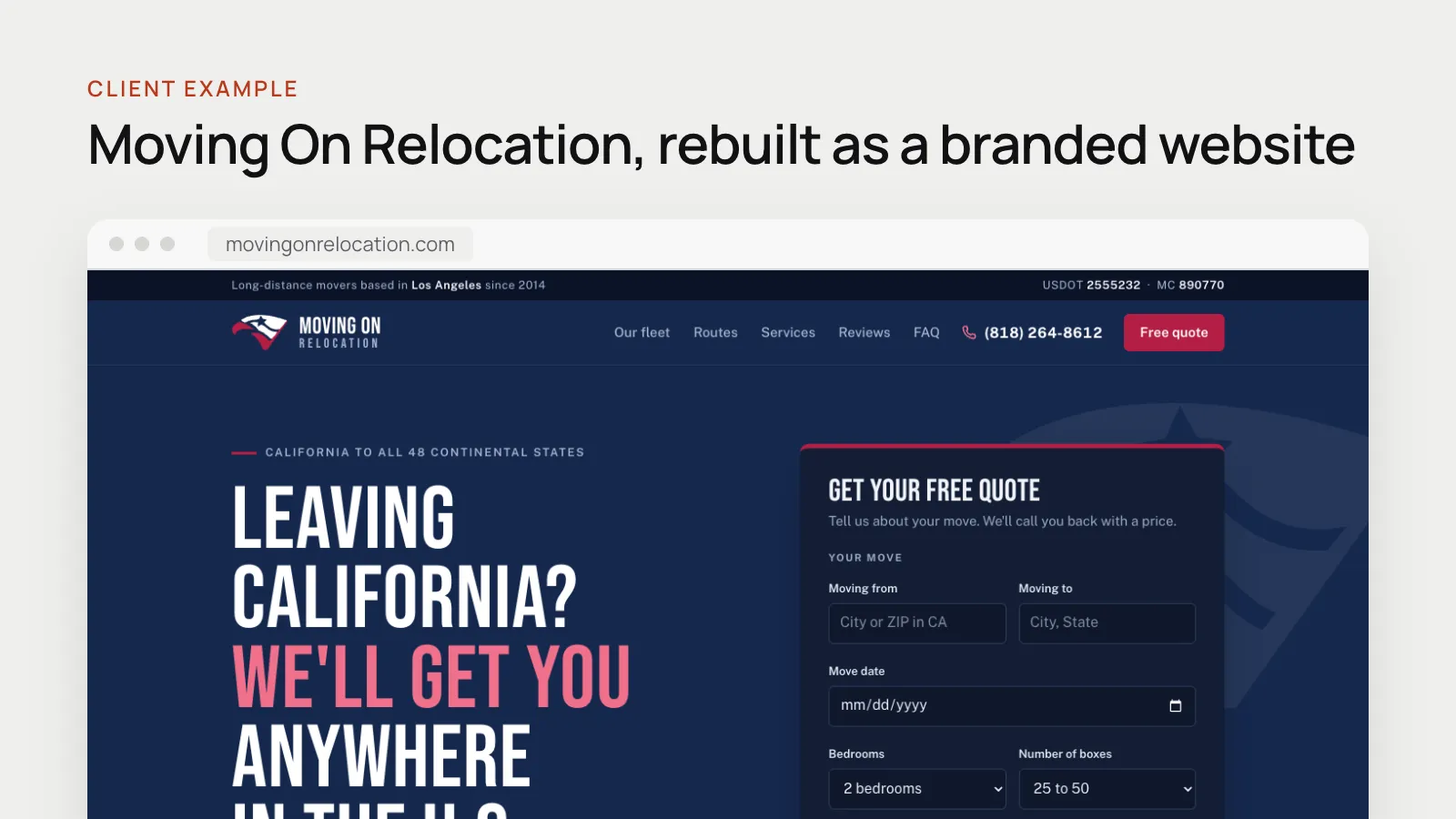
The rebuilt Moving On Relocation homepage.
How to think about the cost
Compare the price of a website to what a new customer is worth to you, not to the cheapest quote you got.
Here is a simple way to do the math. Take what an average customer is worth to you over a year. Multiply it by how many extra customers a better website might bring you each month. Then multiply by twelve.
For example, if a new client is worth $1,500 to you and a better site brings in two more clients a month, that is $36,000 a year. Against that number, the difference between a $3,000 site and a $15,000 site looks very different than it does on a quote.
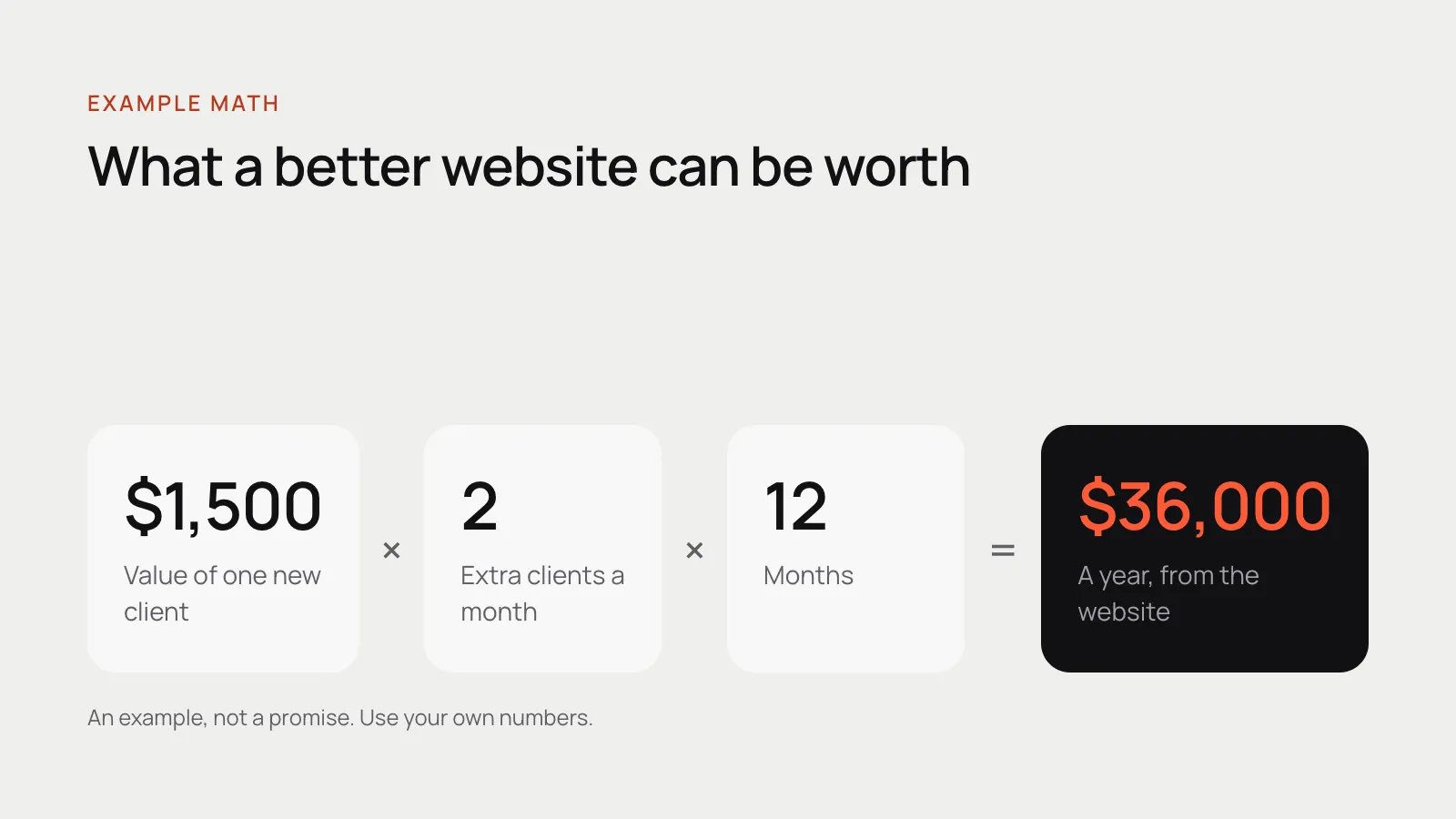
An example, not a promise. Plug in your own numbers.
You do not need exact numbers for this to be useful. Even a rough estimate tells you whether your website is an expense or one of the best investments in your business.
What you will pay after launch
A website keeps costing a little after it goes live. Plan for:
- A domain name: usually $10 to $50 a year.
- Hosting: from free on some platforms to $50 a month or more, depending on the site.
- Care and updates: keeping the site fast, secure and current, either done yourself or covered by a monthly plan.
- Content and search: new pages, posts and Google Business Profile updates if you want to keep climbing in search.
Ask any studio you talk to exactly what is and is not included after launch, so there are no surprises.
When a cheap website is the right call
A cheap website is the right choice when you are just starting out, testing an idea or need a simple page so people can confirm you exist. If most of your work comes from referrals and you are not trying to grow, a clean template site is often enough.
A branded website makes sense when you are ready to grow, when you compete with bigger names in your market, or when you want to charge more than you do today. That is when looking the part starts to pay for itself.
How to budget for yours
Before you ask for quotes, answer three questions:
- What should the website do? More calls, more bookings, more quote requests, or simply looking more professional.
- What is a new customer worth to you? Use the math above.
- What can you do yourself? Writing, photos and updates all cost either money or time.
With those answers, quotes become much easier to compare, because you know what you are actually paying for.
If you are not sure whether your website is costing you customers, tell us about your business. We read every answer and tell you what is holding it back.